This article outlines the top five reasons global B2B buyers focus on tilt lock mechanism stability in office chairs—covering risk reduction, product quality, lifecycle cost, and regional standards.
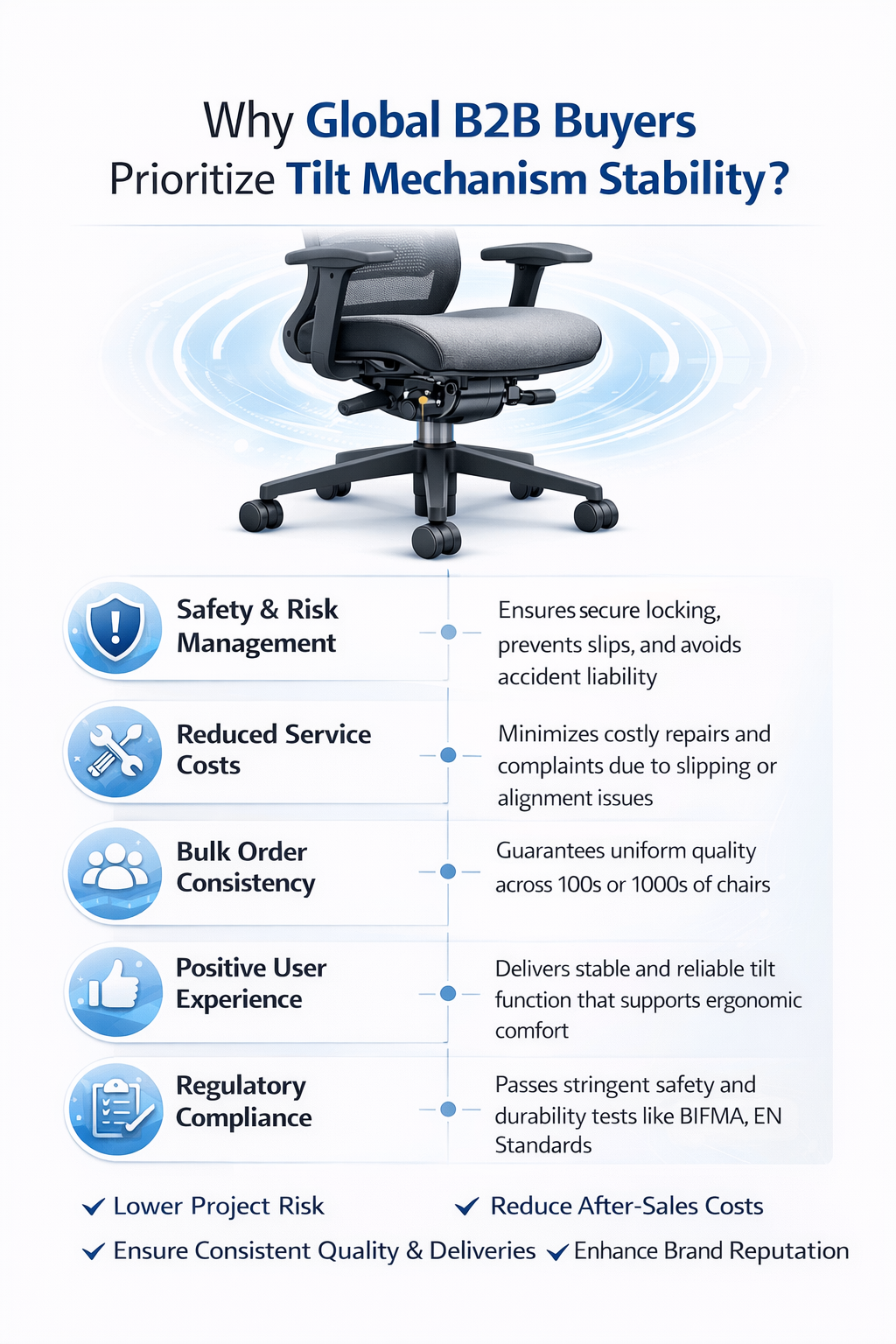
Why Do Global B2B Buyers Prioritize the Stability of Tilt Lock Mechanisms?
In today’s competitive office furniture market, B2B buyers—especially international wholesalers and procurement teams—demand more than just functionality. One factor consistently ranking at the top of their checklist is the stability of the tilt lock mechanism base. This article dives into why this particular component receives heightened scrutiny across global sourcing operations.
1. Risk Mitigation & Liability Protection
Chairs with unstable office chair tilt mechanism bases risk tipping or collapsing—leading to safety claims.
Corporate buyers in the EU and US face strict compliance (e.g., BIFMA, EN1335).
A reliable function mechanism helps prevent employee injury during reclining motion.
Many buyers conduct stress tests specifically on the base and locking mechanism.
Reputable OEMs offer warranties that focus on long-term mechanism replacement support.
2. Quality Assurance & Brand Reputation
Global brands cannot afford product recalls linked to chair malfunctions.
Replacement swivel and tilt lock units must maintain consistent quality across thousands of units.
Inconsistent tilt stability reflects poorly on supplier reliability.
Clients link chair longevity with the sturdiness of this core mechanism.
OEMs promoting certified, reinforced tilt bases gain higher buyer trust.
3. Procurement & Project Scale Considerations
Large orders (1,000+ units) for government or corporate offices need parts that won’t fail prematurely.
Buyers compare tilt lock mechanisms side-by-side during supplier audits.
Projects with tight rollout deadlines prefer proven, low-defect components.
The function mechanism is seen as the "brain" of ergonomic chair operations.
Mechanism replacement compatibility across chair lines streamlines B2B inventory.
4. Long-Term Total Cost of Ownership
A failed tilt mechanism is costly—not just in part replacement but also labor and disruption.
Stability reduces the frequency of warranty service calls.
High-durability base systems improve overall lifecycle ROI.
Ergonomic failures from weak tilt systems lead to productivity losses.
Replacement swivel and tilt controls that last beyond 3–5 years are highly preferred.
5. Regional Market Expectations
European B2B buyers demand low-noise, zero-wobble tilt systems.
US buyers prioritize smooth locking and ANSI/BIFMA-certified components.
Japanese markets expect compact, stable tilt mechanisms with high precision.
Middle Eastern clients often ask about heat and corrosion resistance in the function mechanism.
Across APAC, mechanism replacement flexibility is key to maintenance planning.
SEO Keywords: replacement swivel, function mechanism, mechanism replacement, office chair tilt mechanism, base
Tags: replacement swivel, function mechanism, mechanism replacement, office chair tilt mechanism, base, tilt lock mechanism



.png)




_cVJsSf.png)
_GCnBd3.png)