What Are the Key Differences Between Tilt Lock Mechanisms and Standard Chair Bases?
This article compares tilt lock mechanism bases with standard chair bases across five critical areas—from structure and motion to market application and maintenance considerations.
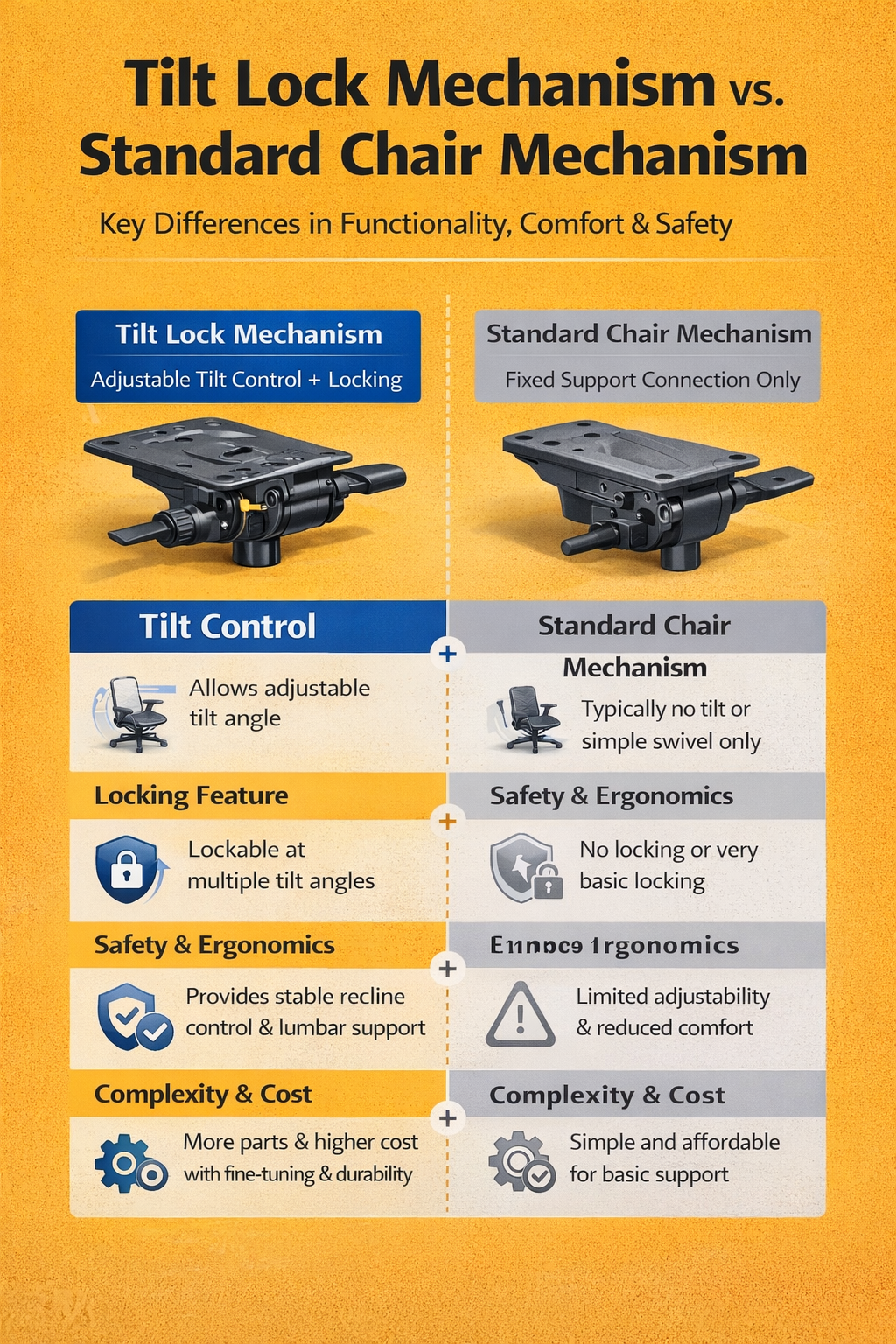
What Are the Key Differences Between Tilt Lock Mechanisms and Standard Chair Bases?
For B2B buyers and product designers in the office chair industry, understanding the distinction between tilt lock mechanism bases and standard bases is critical for performance, safety, and cost optimization. This article offers a comprehensive comparison of both systems across key engineering and functional dimensions.
1. Structural & Engineering Differences
Tilt lock mechanism bases include integrated control housings and lever brackets.
Standard bases are typically static or use basic gas lift connection without locking parts.
Reinforced function mechanism designs are exclusive to tilt models.
Mechanism replacement on tilt bases requires precision fit due to embedded locking slots.
Base materials in tilt models often need higher-grade alloy or fiber-reinforced plastic.
2. Motion & Recline Control
Tilt mechanisms allow adjustable reclining angles with tension control.
Standard bases offer only up-down gas lift movement, no reclining support.
Office chair tilt mechanism includes tilt-lock positions that hold backrest at desired angles.
Replacement swivel used in tilt chairs must withstand both vertical and angular forces.
Advanced tilt systems offer synchronized recline, missing in standard bases.
3. Ergonomics & User Comfort
Tilt lock bases support spinal curvature by enabling backrest flexibility.
Static base designs don’t promote dynamic posture changes.
Function mechanism in tilt models reduces lower back strain by adapting to user motion.
Tilt models enable better customization for different user body types.
Mechanism replacement in ergonomic chairs ensures consistent comfort post-maintenance.
4. Application Scenarios & Market Positioning
Tilt bases are preferred for executive, task, and ergonomic office chairs.
Standard bases are more common in budget chairs, waiting areas, or occasional use models.
Base strength and tilt lock durability determine commercial vs. residential chair usage.
OEMs use tilt lock to market chairs with "advanced ergonomic design".
Replacement swivel in tilt chairs is generally higher quality, supporting premium branding.
5. Cost, Maintenance & Supply Chain Considerations
Tilt lock mechanisms involve higher material and tooling cost.
Mechanism replacement is more technical but preserves higher-value products.
Standard base chairs are easier to mass-produce with fewer variants.
Tilt bases require longer QC cycles due to more moving parts.
Function mechanism in tilt models must comply with additional certifications (e.g., BIFMA, EN1335).
SEO Keywords: replacement swivel, function mechanism, mechanism replacement, office chair tilt mechanism, base
Tags: replacement swivel, function mechanism, mechanism replacement, office chair tilt mechanism, base, tilt vs standard chair base



.png)




_cVJsSf.png)
_GCnBd3.png)